Topics in this domain
- Project Roles and Governance
- PMBOK Phases
- Gantt, PERT, Critical Path
- Function Point Analysis
- Earned Value and Project Risk
- Business Case and Feasibility
- Benefits Realization
- SDLC Phases Overview
- Requirements Definition
- System Design
- Waterfall vs. Iterative vs. Prototyping
- Agile
- DevOps and DevSecOps
- RAD, CASE, Low-Code
- Build, Coding Standards, Code Review
- Testing Levels: Unit, Integration, System, UAT
- Regression, Sociability, Parallel, Pilot Testing
- Defect Management
- Data Migration and Conversion
- Change-Over: Parallel, Phased, Abrupt
- Go-Live Readiness and Acceptance
- Post-Implementation Review
- Input Controls
- Processing Controls
- Output Controls
- Data Integrity and ACID
- EDI and E-Commerce Controls
Business Case and Feasibility
Why should we spend this money?
Before buying a car, you’d think about why you need it, what you can afford, the running costs as well as the price, and whether a bike or the bus would do instead. A business case does the same for an IT project.
A business case explains why an investment should be made. It’s the basis for the decision to fund a project and, later, for checking whether it delivered. It’s owned by the sponsor.
Typical contents:
- the business need or opportunity, and its link to strategy
- options considered, including doing nothing
- costs over the whole life: buying or building, implementing, training, running, maintaining, and eventually retiring the system (total cost of ownership)
- benefits, tangible and intangible, with how and when they’ll be measured
- risks of the project, and of not doing it
- financial analysis: return on investment, net present value, internal rate of return, payback period
- the recommended option and an outline plan
The five feasibility questions
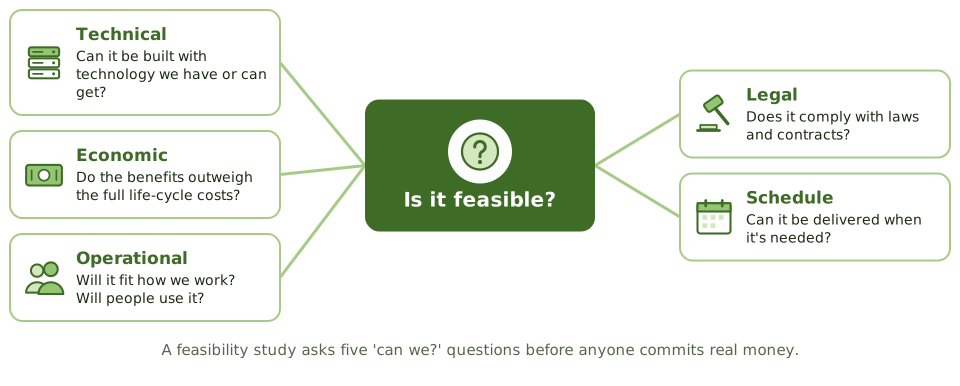
| Dimension | The question |
|---|---|
| Technical | Is the technology available and mature? Will it work with our existing systems? |
| Economic | Do the benefits justify the costs? |
| Operational | Does it fit our processes, skills and culture? Will people actually use it? |
| Legal / regulatory | Data protection, licensing, contracts, sector rules |
| Schedule | Can it be delivered in time? |
The feasibility study also weighs build versus buy, and whether an existing system could meet the need.
Revisit, don’t file away
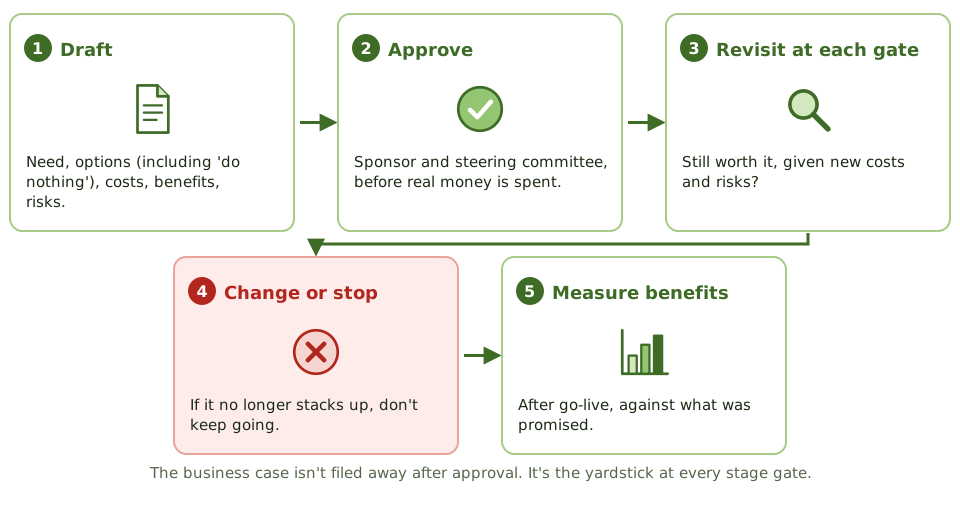
The business case should be reviewed at every stage gate. If costs rise, benefits shrink or the business need changes, the steering committee decides whether to continue, change direction, or stop. Carrying on because money has already been spent is the sunk cost trap.
Example. A warehouse system was approved on a business case of 1.2 million cost and 400,000 a year in savings. Halfway through, costs are forecast at 2.5 million, and the company has outsourced half its warehousing, halving the savings. The auditor checks whether the steering committee re-evaluated the case. It hadn’t, and the project carried on under the original approval.
How the exam asks about it
| If the question asks… | The answer is usually… |
|---|---|
| Who owns the business case? | The project sponsor |
| When the business case is reviewed | At each major stage gate, and when circumstances change |
| The business case is no longer valid | Change or stop the project |
| A cost element often left out | Running, maintenance and retirement costs |
| The feasibility dimension about user acceptance and fit | Operational feasibility |
In short
- The business case justifies an investment: the need, the options, costs, benefits, risks, and how benefits will be measured.
- It's approved before significant money is committed and reviewed at each major stage gate.
- A feasibility study checks whether a solution is technically, economically, operationally, legally and schedule feasible.
- Options should include 'do nothing', and alternatives such as buying, building or outsourcing.
- Financial measures include return on investment, net present value, payback period and total cost of ownership.
- If the business case is no longer valid, the project should be changed or stopped.
Exam traps
- The business case isn't a one-off document; it's revisited throughout the project.
- Costs must cover the whole life: running, maintaining, training and retiring the system, not just building it.
- Intangible benefits still need a way to be measured or evidenced.
- The sponsor owns the business case, not the project manager or IT.
Slides
Click the slide and use the arrow keys. F toggles full screen.
The five feasibility questions
The business case through the project