Topics in this domain
- Project Roles and Governance
- PMBOK Phases
- Gantt, PERT, Critical Path
- Function Point Analysis
- Earned Value and Project Risk
- Business Case and Feasibility
- Benefits Realization
- SDLC Phases Overview
- Requirements Definition
- System Design
- Waterfall vs. Iterative vs. Prototyping
- Agile
- DevOps and DevSecOps
- RAD, CASE, Low-Code
- Build, Coding Standards, Code Review
- Testing Levels: Unit, Integration, System, UAT
- Regression, Sociability, Parallel, Pilot Testing
- Defect Management
- Data Migration and Conversion
- Change-Over: Parallel, Phased, Abrupt
- Go-Live Readiness and Acceptance
- Post-Implementation Review
- Input Controls
- Processing Controls
- Output Controls
- Data Integrity and ACID
- EDI and E-Commerce Controls
Change-Over: Parallel, Phased, Abrupt
Switching from old to new
Think about switching to a new phone. You could carry both for a week until you trust the new one (parallel). You could move your contacts first, then your photos, then your apps (phased). Your partner could try the same model first (pilot). Or you could drop the old phone in a drawer and go (abrupt).
Organisations face exactly this choice when a new system replaces an old one. It’s a trade-off between risk and cost.
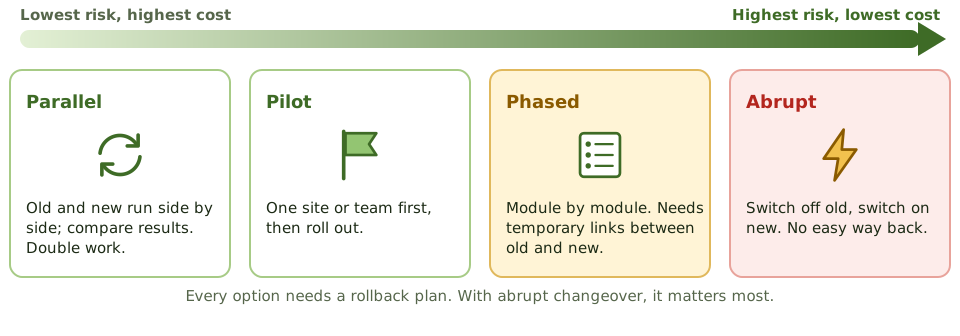
The four methods
| Method | How it works | Advantages | Disadvantages |
|---|---|---|---|
| Parallel | Old and new run at the same time on the same data; results compared until the new one is proven | Lowest risk; old system is a fallback; results can be checked | Costly; double workload; not always technically possible |
| Pilot | New system goes live in one location, department or group first | Problems found with limited impact; lessons for roll-out | Takes longer; the pilot site may not be typical |
| Phased | New system introduced in stages, by module or function | Risk spread over time; people learn gradually | Temporary interfaces between old and new parts; longer overall |
| Abrupt (direct, big bang) | Old system stops and new one starts at a set moment | Cheapest and quickest; no interfaces between old and new | Highest risk; failures hit everyone at once; hard to go back |
Choosing a method
- How critical is the system, and how much disruption can the business tolerate?
- Can the old and new systems run side by side?
- Is there budget and staff for double work?
- How many locations and users are there?
- How modular is the new system?
Example. A bank replaces its core banking system. Running both in parallel is impractical at its transaction volumes, so it uses a phased approach by product (savings first, then loans), pilots each phase at three branches, and has a tested rollback plan for every cutover weekend.
Always have a way back
Every changeover needs a documented rollback (fallback) plan, with the conditions for using it agreed in advance. It’s critical for abrupt changeover, because once data has moved on, the old system may be hard to restart. Even parallel changeover needs one, for example in case data gets corrupted.
Other go-live controls
- a formal go/no-go decision by the business owner and IT
- a detailed cutover runbook with checkpoints
- converted data reconciled before users start
- extra support in the first weeks (hypercare)
- clear communication to users
How the exam asks about it
| If the question asks… | The answer is usually… |
|---|---|
| Changeover with the highest risk | Abrupt / direct |
| Changeover with the lowest risk | Parallel |
| Main disadvantage of parallel | Cost and double workload |
| Main risk of phased changeover | Interfaces between old and new components |
| Implement at one branch first | Pilot |
In short
- Parallel changeover runs old and new systems together until the new one is proven; lowest risk, highest cost.
- Phased changeover introduces the new system in modules or stages; risk spread out, but interfaces between old and new are needed.
- Pilot changeover implements in one location or group first, then rolls out.
- Abrupt (direct, big bang, cutover) switches completely at once; cheapest and fastest, highest risk.
- Whatever the method, a fallback or rollback plan is needed.
- The choice depends on criticality, risk tolerance, cost and whether the systems can run in parallel.
Exam traps
- Abrupt changeover has the highest risk because there's no fallback once the old system stops.
- Parallel is safest but needs extra resources and double data entry.
- Phased needs temporary interfaces between old and new parts, which add risk.
- A rollback plan is needed even for parallel changeover, for example if data is corrupted.
Slides
Click the slide and use the arrow keys. F toggles full screen.
Risk vs cost