Topics in this domain
- ISACA Code of Professional Ethics
- ITAF: The Standards Framework
- Standards vs. Guidelines vs. Tools
- Auditor Independence and Objectivity
- Audit Charter: Purpose and Contents
- Audit Testing: Compliance vs. Substantive
- Financial vs. Operational vs. Integrated Audits
- Forensic and Specialized Audits
- Risk-Based Audit Approach
- Inherent, Control, Detection, and Audit Risk
- Audit Universe and Annual Audit Plan
- Audit Objectives, Scope, and the Audit Program
- Types and Reliability of Audit Evidence
- Sampling: Statistical vs. Non-Statistical
- Sampling Terms: Confidence Level, Tolerable Error and Friends
- Interviews, Observation, and Walkthroughs
- CAATs and Data Analytics
- Continuous Auditing and Monitoring
- Preventive, Detective, Corrective Controls
- General vs. Application Controls
- Compensating Controls and Segregation of Duties
- Materiality and Evaluating Findings
- Audit Report Structure and Communication
- Follow-Up and Management Action Plans
- Control Self-Assessment (CSA)
- Audit Quality and Using Other Experts' Work
Types and Reliability of Audit Evidence
What counts as proof?
An auditor’s conclusion is only as good as the proof behind it. “The IT manager told me it’s fine” isn’t proof. “I pulled the data myself and checked every case” is.
ITAF says evidence must be sufficient and appropriate. That sounds dry, but it boils down to three simple questions.
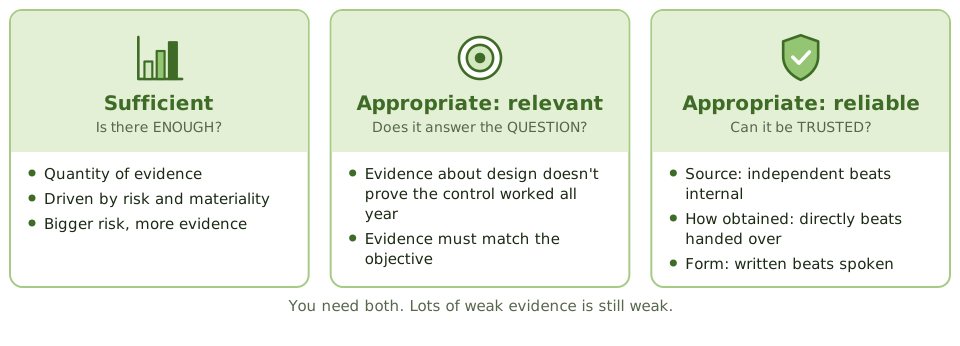
- Sufficient: is there enough? How much depends on risk and materiality. Bigger risk, more evidence.
- Relevant: does it answer the question? Evidence that a control is well designed doesn’t prove it worked all year.
- Reliable: can it be trusted? That depends on where it came from, how it was obtained, and its form.
The two are linked: very reliable evidence means you need less of it. But piling up weak evidence never makes it strong.
Ranking evidence
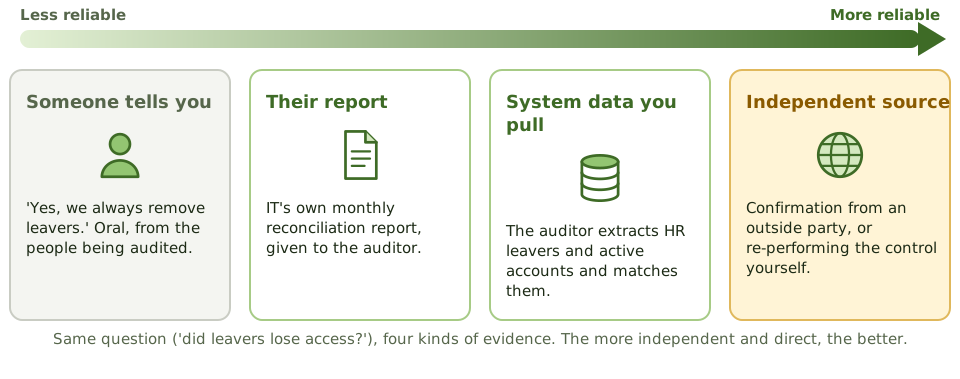
The exam often lists four pieces of evidence and asks which is most reliable. Use these rules:
| More reliable | Less reliable |
|---|---|
| From an independent outside source | From inside the auditee |
| Obtained directly by the auditor | Handed over by the auditee |
| Written or system-generated | Spoken |
| Original documents | Copies, printouts, scans |
| Produced where controls are strong | Produced where controls are weak |
| From someone qualified and independent | From someone with a stake in the result |
| Covers the whole period | A single moment |
Example. To check that leavers lost their system access, the auditor could (a) ask the IT manager, (b) read IT’s own monthly reconciliation report, or (c) extract the HR leavers list and the active user list and match them personally. Option (c) is the most reliable: obtained directly, from the system, covering everyone.
Ways to gather evidence
| Technique | Good for | Watch out for |
|---|---|---|
| Inquiry (interviews, questionnaires) | Understanding how things work | Must be backed up by other evidence |
| Observation | Seeing a process or physical control in action | Only proves what happened while you watched |
| Inspection | Approvals, settings, logs, equipment | Documents can be incomplete or altered |
| Confirmation | Balances, contracts, facts held by outsiders | Depends on getting a reply |
| Re-performance | Proving a control or calculation actually works | Can take time without automation |
| Analytical procedures | Spotting odd trends | Points where to look; doesn’t prove a specific error |
| Data analytics (CAATs) | Testing every transaction | Data must be complete and accurate first |
Electronic evidence
Most IS audit evidence is electronic. Two cautions:
- It can disappear. Logs are often kept only for days or weeks before being overwritten. Ask for them early.
- Check it’s complete. Before analysing extracted data, reconcile record counts and totals to the source system, and confirm the extract covers the whole period.
Work papers
Work papers record what was planned, what was done, what evidence was found and what was concluded. They:
- support every finding in the report
- show the work was supervised and met the standards
- belong to the audit function, are kept as long as policy and law require, and are protected from unauthorised access or changes
How the exam asks about it
| If the question asks… | The answer is usually… |
|---|---|
| The most reliable evidence | Independent outside confirmation, or evidence the auditor obtained directly |
| A manager’s verbal assurance | Weak on its own; corroborate it |
| The auditee provides a printout of user access | Less reliable than the auditor extracting the data |
| Evidence that a control worked throughout the year | Testing a sample across the period, not one observation |
| The auditor can’t get sufficient evidence | It’s a scope limitation; report it |
In short
- Evidence must be sufficient (enough of it) and appropriate (relevant to the question and reliable).
- Evidence from an independent outside source beats evidence from inside the auditee.
- Evidence the auditor gets directly (observing, re-performing, extracting data) beats evidence handed over by the auditee.
- Written or system-generated evidence beats what people say; spoken answers need backing up.
- Evidence produced where controls are strong is more reliable than where they're weak.
- Before analysing system data, check it's complete: record counts and totals should match the source.
- Work papers record the evidence and link it to the conclusions; they're retained and protected.
Exam traps
- A management representation letter is evidence, but weak. It never replaces testing.
- A printout given by the auditee is less reliable than data the auditor extracts directly.
- More of a weak kind of evidence doesn't make it strong.
- Interviewing staff alone never proves a control works.
- Logs and electronic records may be overwritten; request them early.
Slides
Click the slide and use the arrow keys. F toggles full screen.
What counts as proof?
An auditor's conclusion is only as good as the proof behind it. "The IT manager told me it's fine" isn't proof. "I pulled the data myself and checked every case" is.
The standards say evidence must be sufficient and appropriate. That sounds dry, but it boils down to three questions.
Ranking evidence
Imagine the question is 'were leavers' accounts removed?'. Here are four kinds of evidence, from weakest to strongest.