Topics in this domain
- ISACA Code of Professional Ethics
- ITAF: The Standards Framework
- Standards vs. Guidelines vs. Tools
- Auditor Independence and Objectivity
- Audit Charter: Purpose and Contents
- Audit Testing: Compliance vs. Substantive
- Financial vs. Operational vs. Integrated Audits
- Forensic and Specialized Audits
- Risk-Based Audit Approach
- Inherent, Control, Detection, and Audit Risk
- Audit Universe and Annual Audit Plan
- Audit Objectives, Scope, and the Audit Program
- Types and Reliability of Audit Evidence
- Sampling: Statistical vs. Non-Statistical
- Sampling Terms: Confidence Level, Tolerable Error and Friends
- Interviews, Observation, and Walkthroughs
- CAATs and Data Analytics
- Continuous Auditing and Monitoring
- Preventive, Detective, Corrective Controls
- General vs. Application Controls
- Compensating Controls and Segregation of Duties
- Materiality and Evaluating Findings
- Audit Report Structure and Communication
- Follow-Up and Management Action Plans
- Control Self-Assessment (CSA)
- Audit Quality and Using Other Experts' Work
Financial vs. Operational vs. Integrated Audits
Same company, different questions
Picture a company that sells furniture online. Auditors could ask many different questions about it:
- Are its accounts right?
- Is its warehouse process efficient?
- Does it follow the card payment rules?
- Are its systems secure?
Each question is a different type of audit. The type is simply named after the question being asked.
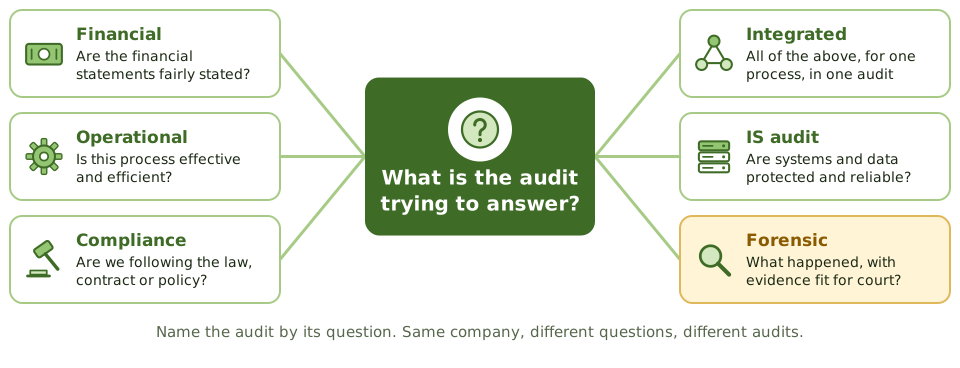
The main types
| Type | The question it answers | Where IT comes in |
|---|---|---|
| Financial audit | Are the financial statements fairly presented? | Only as far as systems affect the numbers: IT general and application controls |
| Operational audit | Are processes and their controls effective and efficient? | Can cover IT processes such as operations or service management |
| Integrated audit | A combined view of one business process or asset | Business and IS auditors work together |
| Compliance audit | Does the organisation follow a specific law, regulation, contract or policy? | Privacy, PCI DSS, software licensing, sector rules |
| Administrative audit | Is a function run efficiently and productively? | Office or process productivity |
| IS audit | Are systems and data protected, reliable and well managed? | The main focus |
The integrated audit
Imagine three separate teams auditing how the furniture company pays its suppliers: the financial auditors check the invoices, the operational auditors check the process, and the IS auditors check the ERP system. They’d interview the same people three times and test overlapping things.
An integrated audit puts them together. The team looks at the business risks and the IT controls those risks depend on, tests everything once, and writes one report.
Example. An integrated audit of “procure to pay” covers the purchase approval workflow, the ERP’s three-way match (order, delivery, invoice), changes to supplier bank details, and who has access to the purchasing module, all in one engagement.
Benefits the exam looks for:
- a broader view of risk across business and IT
- no duplicated testing
- one report for management
Compliance audit vs compliance testing
The words are similar, which is the trap.
- A compliance audit is a type of audit: does the organisation follow PCI DSS, a privacy law, or a software licence?
- Compliance testing is a type of test inside any audit: does a particular control work as designed?
Other audits you’ll see named
- Third-party service audits, such as SOC 1 and SOC 2 reports on outsourced providers
- Fraud audits, focused on detecting and investigating fraud
- Forensic audits, gathering evidence to a legal standard (covered in the next topic)
How the exam asks about it
| If the scenario describes… | It’s a… |
|---|---|
| Assessing the fairness of financial statements | Financial audit |
| Evaluating whether a process is efficient and achieving its goals | Operational audit |
| Business and IT auditors reviewing one process together | Integrated audit |
| Checking adherence to a regulation or contract | Compliance audit |
| Evidence gathered for possible legal proceedings | Forensic audit |
| The main benefit of an integrated audit | A broader view of risk with less duplicated work |
In short
- An audit's type is defined by its objective: the question it's trying to answer.
- Financial audit: are the financial statements fairly presented? IT is looked at only as far as it affects them.
- Operational audit: are processes and their controls effective and efficient?
- Integrated audit: financial, operational and IS audit work combined to look at one business process end to end.
- Compliance audit: does the organisation follow a specific law, regulation, contract or policy?
- Administrative audits look at efficiency and productivity; IS audits look at systems, controls and data.
- Forensic audits gather evidence to a legal standard.
Exam traps
- An integrated audit combines audit TYPES on one process. It doesn't mean auditing the whole company.
- Compliance AUDIT (a type of audit) and compliance TESTING (testing controls) are different things.
- A financial audit doesn't assess whether IT is efficient; it only looks at IT as it affects the financial statements.
Slides
Click the slide and use the arrow keys. F toggles full screen.
Same company, different questions
Auditors can look at the same company and ask very different questions. The type of audit is just a name for the question being asked.