Topics in this domain
- IT Governance vs. IT Management
- Board and Senior Management Roles
- IT Steering Committee
- IT Strategy and Business Alignment
- Balanced Scorecard
- COBIT
- ITIL
- ISO 27001/27002
- COSO: ERM and Internal Control
- Policies, Standards, Procedures, Guidelines
- IT Organizational Structure and Key Roles
- Segregation of Duties in IT
- Enterprise Architecture (Zachman, TOGAF)
- Risk Management Process
- Qualitative vs. Quantitative Risk Assessment
- Risk Responses: Mitigate, Transfer, Avoid, Accept
- Risk Appetite and Residual Risk
- Maturity Models (CMMI)
- KPIs and KGIs
- Outsourcing: Benefits and Risks
- Vendor Selection, Contracts, SLAs, Right to Audit
- Cloud and Offshore Governance
- Portfolio and Resource Management
- HR: Hiring, Training, Termination
- Legal and Regulatory Compliance
- Quality Management
IT Governance vs. IT Management
Steering and rowing
Picture a rowing boat. Someone decides where the boat should go and keeps checking it’s on course: that’s governance. The crew rows, trims the sails and fixes leaks: that’s management. A brilliant crew rowing in the wrong direction gets nowhere useful, and a perfect course is pointless if nobody rows.
COBIT draws this line clearly, and the exam uses it often.
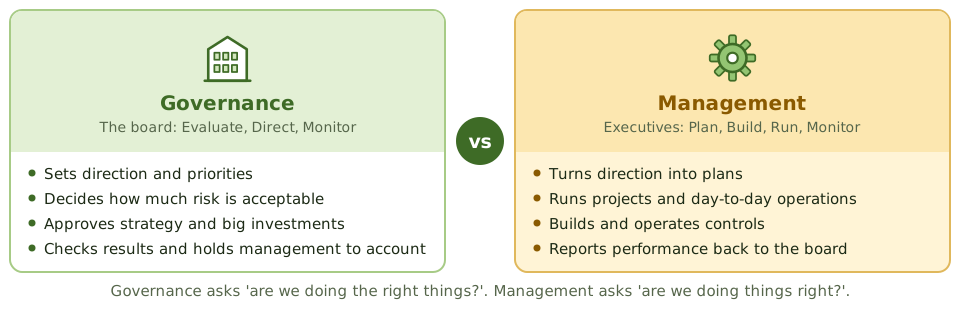
| Governance | Management | |
|---|---|---|
| Who | Board of directors | Executive management, led by the CEO |
| Activities | Evaluate, Direct, Monitor (EDM) | Plan, Build, Run, Monitor (PBRM) |
| Concern | Setting objectives and direction; making sure stakeholder needs are met | Achieving those objectives |
| Outputs | Approved strategy, risk appetite, priorities, oversight of performance | Plans, projects, services, operational reports |
A shortcut: governance asks “are we doing the right things?” Management asks “are we doing things right?”
What IT governance is
IT governance is the part of corporate governance that makes sure IT supports the organisation’s strategy and goals. It’s made up of leadership, structures and processes, and the board is accountable for it. It isn’t something IT does on its own.
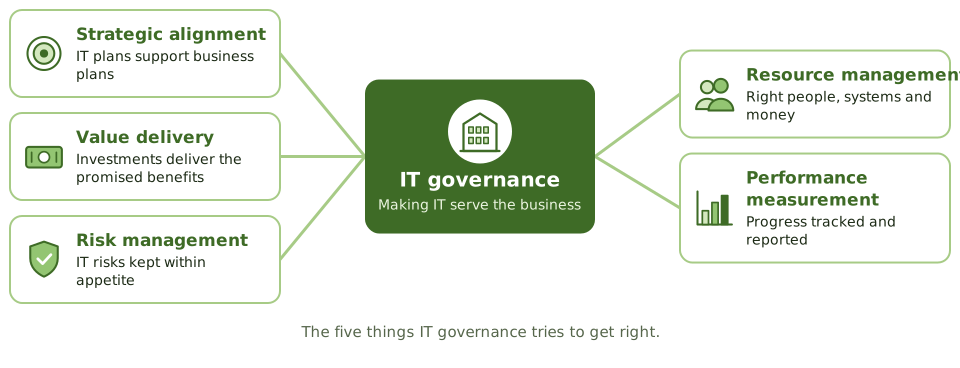
- Strategic alignment: IT plans support business plans.
- Value delivery: IT investments deliver the benefits promised, on time and on budget.
- Risk management: IT risks are understood and kept within the organisation’s appetite.
- Resource management: the right investment in people, systems, infrastructure and information.
- Performance measurement: progress tracked and reported, often with a balanced scorecard.
Who sits where
| Body | Level | Role |
|---|---|---|
| Board of directors | Governance | Accountable; sets direction and risk appetite |
| IT strategy committee | Governance (board level) | Advises the board on IT strategy |
| Audit committee | Governance | Oversees audit, risk and control |
| IT steering committee | Management | Prioritises projects and monitors delivery |
| CIO and IT management | Management | Runs IT |
Auditing IT governance
The auditor looks for evidence that:
- the board and senior management are actually involved in IT direction, not just told afterwards
- the IT strategy is written down, approved, and linked to the business strategy
- risk appetite covers IT risk
- committees and roles exist with clear responsibilities
- IT performance is measured and reported to the board
Example. IT runs smoothly and projects finish on time, but the board hasn’t discussed IT since approving a budget three years ago, and the CIO alone decides what to invest in. The governance finding is the lack of board-level direction and oversight of IT, however well IT is managed.
How the exam asks about it
| If the question asks… | The answer is usually… |
|---|---|
| Who is ultimately accountable for IT governance? | The board of directors |
| Which activity is governance rather than management? | Setting direction, approving strategy and appetite, monitoring performance |
| Main objective of IT governance | Aligning IT with business goals and delivering value |
| Best indicator of effective IT governance | Board and senior management involvement in IT direction |
| Which body advises the board on IT strategy? | The IT strategy committee |
In short
- Governance evaluates options, sets direction and monitors results (EDM). It's the board's job.
- Management plans, builds, runs and monitors activities within that direction (PBRM). It's executive management's job.
- IT governance is part of corporate governance, not something IT does on its own.
- IT governance focuses on strategic alignment, value delivery, risk management, resource management and performance measurement.
- Governance asks 'are we doing the right things?'; management asks 'are we doing things right?'.
- IT running smoothly day to day doesn't prove IT governance is good.
Exam traps
- Setting direction and monitoring = governance. Planning and running = management.
- The CIO is a manager. Accountability for IT governance sits with the board.
- The IT steering committee supports governance but is a management-level body.
- Good operations don't prove good governance; ask whether the board is involved in IT direction.
Slides
Click the slide and use the arrow keys. F toggles full screen.
Governance vs management
What IT governance tries to get right