Topics in this domain
- IT Governance vs. IT Management
- Board and Senior Management Roles
- IT Steering Committee
- IT Strategy and Business Alignment
- Balanced Scorecard
- COBIT
- ITIL
- ISO 27001/27002
- COSO: ERM and Internal Control
- Policies, Standards, Procedures, Guidelines
- IT Organizational Structure and Key Roles
- Segregation of Duties in IT
- Enterprise Architecture (Zachman, TOGAF)
- Risk Management Process
- Qualitative vs. Quantitative Risk Assessment
- Risk Responses: Mitigate, Transfer, Avoid, Accept
- Risk Appetite and Residual Risk
- Maturity Models (CMMI)
- KPIs and KGIs
- Outsourcing: Benefits and Risks
- Vendor Selection, Contracts, SLAs, Right to Audit
- Cloud and Offshore Governance
- Portfolio and Resource Management
- HR: Hiring, Training, Termination
- Legal and Regulatory Compliance
- Quality Management
IT Steering Committee
Who decides which projects go ahead?
Every department wants something from IT: a new CRM, a faster website, a payroll upgrade, better reporting. There’s never enough money or people for all of it. Someone has to decide.
The IT steering committee is where business leaders and IT decide together which projects go ahead, and then keep an eye on them. It sits between the board’s strategic direction and the day-to-day work of IT and project teams.
Strategy committee vs steering committee
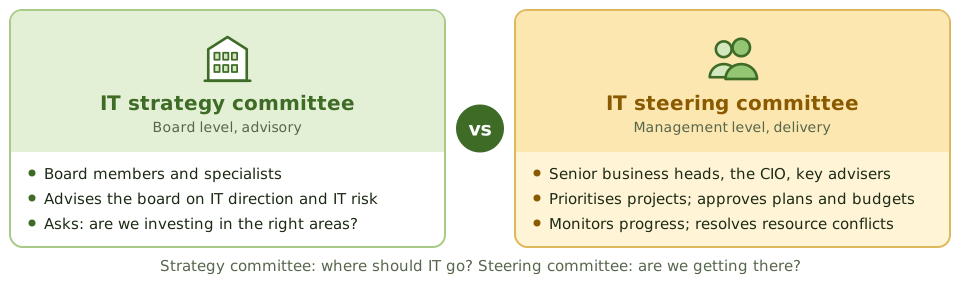
| IT strategy committee | IT steering committee | |
|---|---|---|
| Level | Board | Executive management |
| Role | Advises the board on direction and IT risk | Oversees delivery of that direction |
| Typical question | Is IT strategy aligned? Are we investing in the right areas? | Which projects go ahead? Are they on track? |
What the steering committee does
- reviews and prioritises proposed IT projects and investments
- approves project plans, budgets and big scope changes
- monitors major projects for progress, cost, risk and benefits
- allocates shared resources and resolves conflicts over them
- monitors service levels and IT performance
- reports to senior management, and in summary to the board
Who should be on it
Senior representatives from the business units that depend on IT, plus the CIO and key advisers (security, architecture, finance), often chaired by a sponsoring executive.
Business representation is the whole point. A committee made up only of IT managers can’t ensure IT priorities match business priorities.
What the auditor checks
- a written charter setting out authority, responsibilities and membership
- membership with senior business representatives
- regular meetings with recorded minutes
- decisions that can be traced to business strategy
- monitoring of approved projects and follow-up of actions
The best evidence the committee actually works is its minutes: who attended, what was decided, and how it was followed up.
Example. The auditor finds the steering committee met twice in 18 months, attended only by IT managers. Meanwhile three big projects started with no recorded approval. The finding: the business has no effective way to prioritise or oversee IT investment.
How the exam asks about it
| If the question asks… | The answer is usually… |
|---|---|
| Main function of the IT steering committee | Prioritise and oversee IT projects and investments in line with the business |
| Best evidence the committee is effective | Minutes showing decisions and follow-up |
| A weakness in committee membership | No senior business representation |
| Difference from the IT strategy committee | Steering = management level, delivery; strategy = board level, advisory |
In short
- The IT steering committee is a management-level group that prioritises IT investments and oversees major projects and resources.
- It includes senior business representatives, not just IT, so decisions reflect business priorities.
- The IT strategy committee works at board level and advises on strategy; the steering committee works at management level on delivery.
- It should have a written charter setting out its responsibilities, authority and members.
- Minutes and recorded decisions are the best evidence it actually works.
Exam traps
- A steering committee of only IT managers can't make sure IT matches business priorities.
- The steering committee oversees and decides; it doesn't do detailed project management.
- A charter alone doesn't prove the committee works; minutes do.
- Strategy committee = board, advisory. Steering committee = management, delivery.
Slides
Click the slide and use the arrow keys. F toggles full screen.
Strategy committee vs steering committee