Topics in this domain
- IT Governance vs. IT Management
- Board and Senior Management Roles
- IT Steering Committee
- IT Strategy and Business Alignment
- Balanced Scorecard
- COBIT
- ITIL
- ISO 27001/27002
- COSO: ERM and Internal Control
- Policies, Standards, Procedures, Guidelines
- IT Organizational Structure and Key Roles
- Segregation of Duties in IT
- Enterprise Architecture (Zachman, TOGAF)
- Risk Management Process
- Qualitative vs. Quantitative Risk Assessment
- Risk Responses: Mitigate, Transfer, Avoid, Accept
- Risk Appetite and Residual Risk
- Maturity Models (CMMI)
- KPIs and KGIs
- Outsourcing: Benefits and Risks
- Vendor Selection, Contracts, SLAs, Right to Audit
- Cloud and Offshore Governance
- Portfolio and Resource Management
- HR: Hiring, Training, Termination
- Legal and Regulatory Compliance
- Quality Management
ITIL
IT as a service
Users don’t care about servers, databases and networks. They care that email works, payroll runs and the website is up. IT service management (ITSM) treats IT as a set of services, each with an agreed level of quality, and organises IT’s work around delivering them.
ITIL is the most widely used body of good practice for ITSM. ITIL 4 describes practices (previously called processes) within a service value system.
Think of a restaurant. Diners don’t care how the kitchen is organised; they care that the food arrives hot, on time, and as ordered. ITIL is like a manual for running the kitchen so that happens every time.
Where ITIL fits
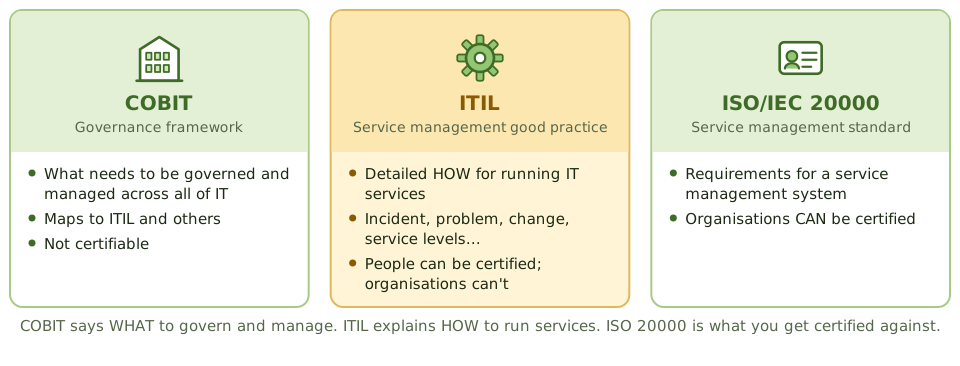
| Framework | What it does | Certifiable? |
|---|---|---|
| ITIL | Detailed guidance on managing IT services | Individuals yes; organisations no |
| ISO/IEC 20000 | Requirements for a service management system | Yes, organisations |
| COBIT | Governance and management of all of IT; maps to ITIL and others | No (it’s a framework) |
COBIT tells you what needs to be governed and managed; ITIL gives the detailed how for running services.
Practices that turn up in questions
| Practice | Purpose |
|---|---|
| Service desk | Single point of contact for incidents and requests |
| Incident management | Restore normal service as quickly as possible |
| Problem management | Find the root causes of incidents and stop them recurring |
| Change enablement | Make changes succeed through assessment, approval and scheduling |
| Release management | Make new and changed services available |
| Service configuration management | Keep accurate information about IT components (the CMDB) |
| Service level management | Set business-based targets and monitor performance against them |
| Service request management | Handle standard requests: access, password resets, equipment |
| Capacity and performance management | Make sure services can handle current and future demand |
| Information security management | Protect the information the organisation needs |
| Continual improvement | Keep practices and services aligned with changing needs |
Each one is covered in detail in Domain 4.
How the practices connect
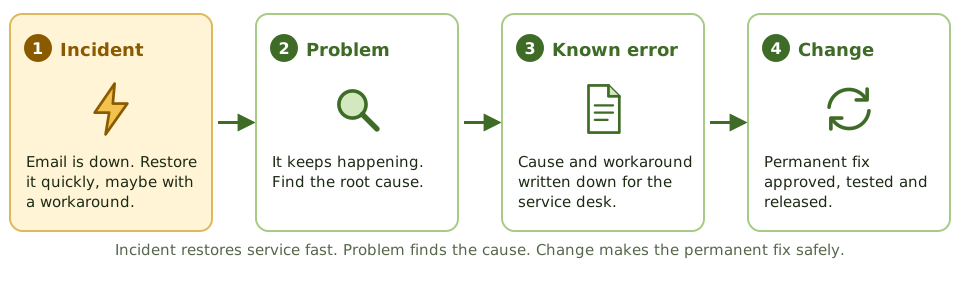
Example. Users report an email outage every Monday morning. The service desk restores service each time (incident management). Problem management traces it to a weekend batch job that fills the mail server’s disk, records the known error, and raises a change to reschedule the job.
Auditing service management
The auditor checks that practices are defined, followed and measured: tickets are logged and categorised, priorities are set by impact and urgency, SLAs are monitored, problems are investigated for root cause, and changes go through change control. COBIT’s DSS and BAI objectives give the criteria.
How the exam asks about it
| If the question asks… | The answer is usually… |
|---|---|
| Framework focused on IT service management | ITIL |
| Certifiable service management standard | ISO/IEC 20000 |
| Primary goal of incident management | Restore service as quickly as possible |
| Primary goal of problem management | Find and remove root causes |
| Single point of contact for users | Service desk |
In short
- ITIL is good-practice guidance for IT service management: running IT as services that deliver value to users.
- COBIT says what to govern and manage; ITIL gives the detailed how for service management.
- ISO/IEC 20000 is the certifiable service management standard; organisations can't be certified to ITIL.
- Practices the exam uses most: service desk, incident, problem, change, service level, configuration and release management.
- Incident management restores service fast; problem management finds and removes root causes.
- The service desk is the single point of contact for users.
Exam traps
- ITIL isn't a governance framework; COBIT is.
- Organisations get certified to ISO 20000, not to ITIL.
- Incident management's goal is fast restoration, not root cause.
- A workaround keeps things going; the permanent fix goes through change management.
Slides
Click the slide and use the arrow keys. F toggles full screen.
Where ITIL fits
How the practices connect