Topics in this domain
- IT Service Management
- Hardware Components and Architecture
- Operating Systems
- OSI Model
- TCP/IP and Common Protocols
- Network Devices: Switches, Routers, Gateways
- LAN/WAN Topologies
- Database Models and DBMS
- Database Controls and Normalization
- Asset Management
- Configuration Management
- Job Scheduling and Batch Processing
- Incident Management
- Problem Management
- Change Management
- Release and Patch Management
- Service Level Management
- Capacity and Performance Monitoring
- End-User Computing
- BCP Lifecycle
- Business Impact Analysis
- RTO, RPO, MTD, SDO
- Recovery Strategies
- Alternate Sites: Hot, Warm, Cold
- Backup Types: Full, Incremental, Differential
- Backup Storage and Rotation
- DRP Contents
- Testing BCP/DRP
- High Availability, RAID, Insurance
- Auditing BCP
Incident Management
Get it working again
When a pipe bursts, the first job is to stop the water and get the kitchen usable again. Working out why the pipe burst comes later, and is somebody else’s job.
An incident is any unplanned interruption to a service, or drop in its quality. Incident management has one goal: restore normal service as quickly as possible and keep the business impact small.
The process
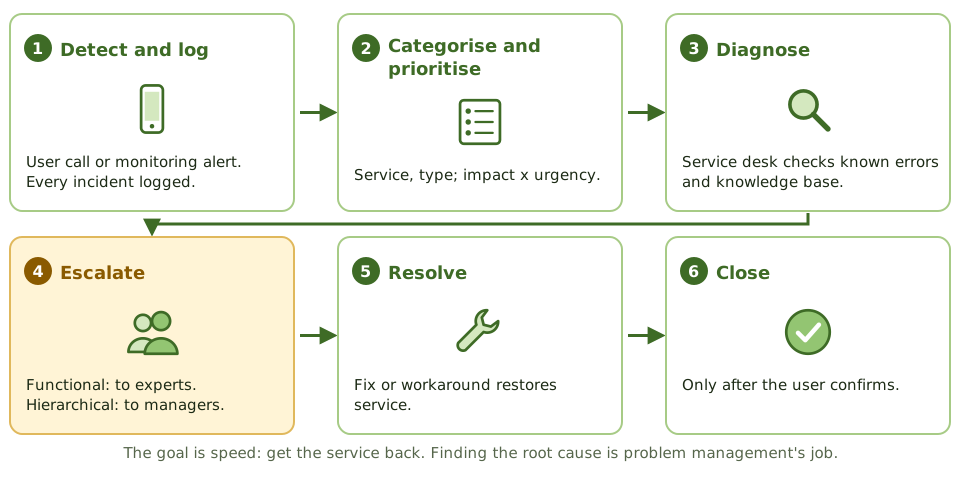
- Detect and log: users report through the service desk, or monitoring raises an alert. Every incident is logged.
- Categorise by service, component and type, so trends can be analysed.
- Prioritise by impact (how many users, how critical the service) and urgency (how soon it hurts).
- Diagnose: the service desk checks known error records and the knowledge base.
- Escalate if needed:
- functional escalation goes sideways, to a more specialist team
- hierarchical escalation goes upwards, to managers, when SLAs are at risk or bigger decisions are needed
- Resolve: a fix or a workaround gets the service back.
- Close, only once the user confirms it’s working, with the resolution recorded. Closing without confirmation makes the metrics look better than reality.
Major incidents
Incidents with severe business impact follow a separate, faster procedure: a named incident manager, a dedicated team, shorter timescales, regular updates to stakeholders, and a review afterwards.
Incident vs problem
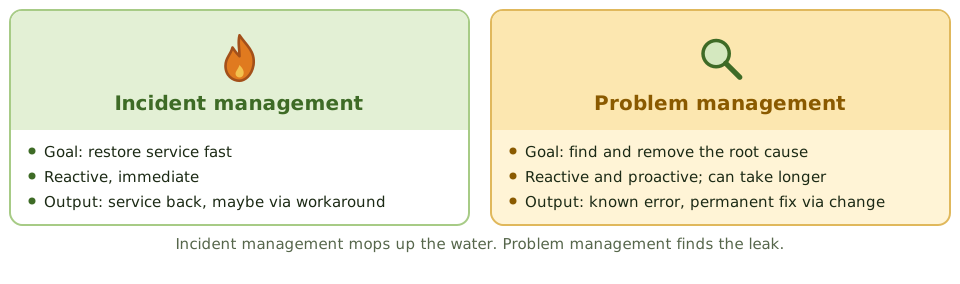
| Incident management | Problem management | |
|---|---|---|
| Goal | Restore service fast | Find and remove the root cause |
| Timing | Reactive, immediate | Reactive and proactive; can take longer |
| Output | Service restored, perhaps via a workaround | Known error record; permanent fix through change |
Incidents that keep coming back should trigger a problem record.
Example. Users report slow access to the CRM every morning. Each time, the service desk restarts the application server and closes the ticket. Forty tickets later, nobody has raised a problem record. The finding: incident management works in isolation, and recurring incidents aren’t analysed.
Security incidents are different
Security incidents (malware, breaches, unauthorised access) follow the incident response process covered in Domain 5. The service desk must recognise them and route them correctly, because evidence must be preserved and legal or regulatory notification may apply. A quick “restart and close” can destroy the evidence.
How the exam asks about it
| If the question asks… | The answer is usually… |
|---|---|
| Primary objective of incident management | Restore service as quickly as possible |
| How priority is set | Impact and urgency |
| Escalation to a more skilled team | Functional escalation |
| Recurring incidents with the same symptoms | Raise a problem record for root cause analysis |
| When to close an incident | After the user confirms resolution |
In short
- Incident management restores normal service as quickly as possible and minimises business impact.
- Every incident is logged, categorised and prioritised by impact and urgency.
- Functional escalation moves an incident to a more skilled team; hierarchical escalation involves management.
- Workarounds restore service; root cause analysis belongs to problem management.
- Major incidents follow a separate, faster procedure with dedicated communication.
- Incidents are closed only after the user confirms service is restored.
Exam traps
- The goal of incident management is restoring service, not finding root cause.
- Security incidents follow the incident response process, with evidence preservation, and may need different handling.
- Closing incidents without user confirmation distorts metrics.
- Repeated incidents with no linked problem record show the incident and problem processes aren't connected.
Slides
Click the slide and use the arrow keys. F toggles full screen.
The process
Incident vs problem