Topics in this domain
- IT Service Management
- Hardware Components and Architecture
- Operating Systems
- OSI Model
- TCP/IP and Common Protocols
- Network Devices: Switches, Routers, Gateways
- LAN/WAN Topologies
- Database Models and DBMS
- Database Controls and Normalization
- Asset Management
- Configuration Management
- Job Scheduling and Batch Processing
- Incident Management
- Problem Management
- Change Management
- Release and Patch Management
- Service Level Management
- Capacity and Performance Monitoring
- End-User Computing
- BCP Lifecycle
- Business Impact Analysis
- RTO, RPO, MTD, SDO
- Recovery Strategies
- Alternate Sites: Hot, Warm, Cold
- Backup Types: Full, Incremental, Differential
- Backup Storage and Rotation
- DRP Contents
- Testing BCP/DRP
- High Availability, RAID, Insurance
- Auditing BCP
Problem Management
Finding the leak
Incident management mops up the water. Problem management climbs into the ceiling, finds the leaking pipe and replaces it, so you stop needing the mop.
Problem management finds the root causes of incidents and removes them, so the incidents don’t come back. It complements incident management, which restores service quickly without necessarily knowing why it failed.
| Term | Meaning |
|---|---|
| Problem | The underlying cause, or potential cause, of one or more incidents |
| Known error | A problem whose root cause has been found and documented, usually with a workaround |
| Workaround | A way to reduce or remove the impact of an incident without fixing the cause |
| Known error database (KEDB) | The store of known errors and workarounds that the service desk uses to fix incidents faster |
A workaround isn’t a resolution. The problem stays open until the root cause is removed, or the risk is formally accepted.
The process
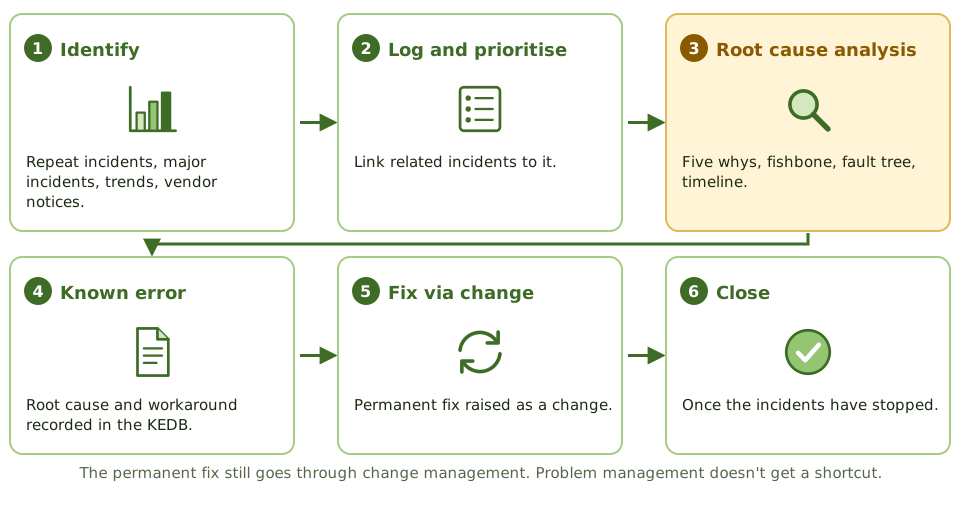
- Identify problems from major incidents, repeat incidents, trend analysis, monitoring or supplier notices.
- Log and prioritise the problem, linking the related incidents to it so the business impact is visible.
- Investigate with root cause analysis.
- Record a known error with its workaround.
- Resolve it by raising a change for the permanent fix. Problem management doesn’t get to skip change approval.
- Close once the incidents have stopped; review major problems.
The CMDB helps here: it shows which components different incidents have in common.
Root cause analysis
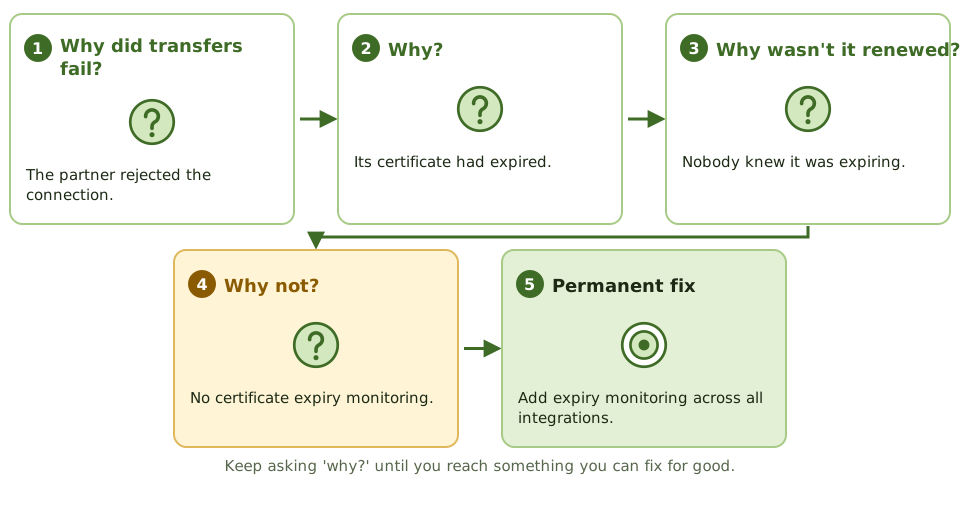
The five whys is the simplest technique: keep asking “why?” until you reach something you can fix for good. Others include fishbone (Ishikawa) diagrams, fault tree analysis and timeline analysis.
Reactive and proactive
- Reactive problem management responds to incidents that have already happened.
- Proactive problem management analyses incident trends, monitoring data and vendor information to find and fix weaknesses before they cause incidents. It’s a sign of a mature process. Without trend analysis, problem management can only ever be reactive.
Example. Over three months, 60 incidents of failed overnight file transfers are logged and closed after manual resubmission. Problem management traces them to an expired certificate on one partner’s server and no expiry monitoring. A change adds certificate monitoring across all integrations, and the incidents stop.
How the exam asks about it
| If the question asks… | The answer is usually… |
|---|---|
| Primary goal of problem management | Find and eliminate root causes; prevent recurrence |
| Problem with a known root cause and workaround | Known error |
| Proactive problem management | Trend analysis to prevent incidents before they occur |
| How the permanent fix is implemented | Through change management |
| Best indicator problem management works | Fewer recurring incidents |
In short
- Problem management identifies the root causes of incidents and prevents them from recurring.
- A problem is the underlying cause of one or more incidents; a known error is a problem with a documented root cause and workaround.
- Reactive problem management responds to incidents; proactive problem management analyses trends to find issues before they cause incidents.
- Root cause analysis techniques include the five whys, fishbone (Ishikawa) diagrams and fault tree analysis.
- Permanent fixes are implemented through change management.
- The known error database helps the service desk resolve incidents faster.
Exam traps
- Problem management isn't about restoring service fast; that's incident management.
- A workaround isn't a resolution; the problem stays open until the root cause is removed or the risk is accepted.
- Fixes found by problem management still need change approval.
- Without incident trend analysis, problem management is purely reactive.
Slides
Click the slide and use the arrow keys. F toggles full screen.
The process
Asking 'why?' five times