Topics in this domain
- Security Governance and Roles
- Data Classification and Ownership
- Security Policies
- Privacy Principles and GDPR
- Identity Management
- Authentication Factors
- Biometrics
- Access Models: DAC, MAC, RBAC
- Logical and Privileged Access
- Cryptography Basics
- Symmetric Encryption
- Asymmetric Encryption
- Hashing and Integrity
- Digital Signatures
- PKI and Certificates
- Firewalls
- IDS/IPS
- VPN, SSL/TLS, IPsec
- Wireless Security
- Endpoint and Mobile (BYOD)
- Cloud and Virtualization Security
- Physical Access Controls
- Environmental Controls: Fire, Power, HVAC
- Social Engineering
- Malware
- Network Attacks: DoS, Spoofing, Sniffing
- Application Attacks: SQLi, XSS
- Vulnerability Management and Pen Testing
- Incident Response
- Digital Forensics and Chain of Custody
- Security Awareness Training
- Logging, SIEM, and Auditing Security
Data Classification and Ownership
Not everything needs a safe
At home, you don’t lock the TV guide in a safe, but you probably keep your passport somewhere secure. Protecting everything to the highest level would be expensive and exhausting. Protecting nothing would be reckless.
Data classification sorts information by:
- sensitivity: how much harm if it’s disclosed
- criticality: how much harm if it’s lost or corrupted
so that controls and costs match the risk. It also makes policies practical: rules are written once per level, not once per document.
A typical scheme
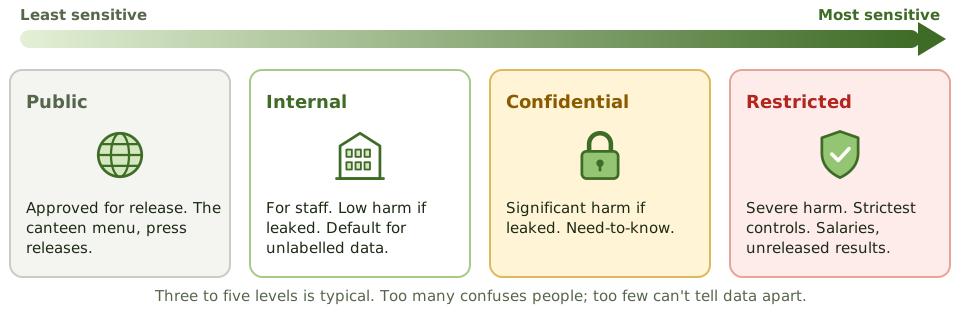
Most organisations use three to five levels, for example:
- Public: approved for release
- Internal: for staff; low harm if disclosed
- Confidential: significant harm if disclosed; need-to-know only
- Restricted / secret: severe harm; strictest controls
Government schemes use levels like confidential, secret and top secret. Too many levels confuses users; too few can’t tell data apart.
Who decides
| Role | Responsibility |
|---|---|
| Data owner | A business manager who decides the classification, approves access, and reviews both periodically |
| Data custodian | Puts the required controls in place (IT, DBAs, storage teams) |
| Data user | Handles data according to its classification |
The owner decides. IT and security provide the scheme and the tools, but they don’t classify on the business’s behalf.
The level drives the rules
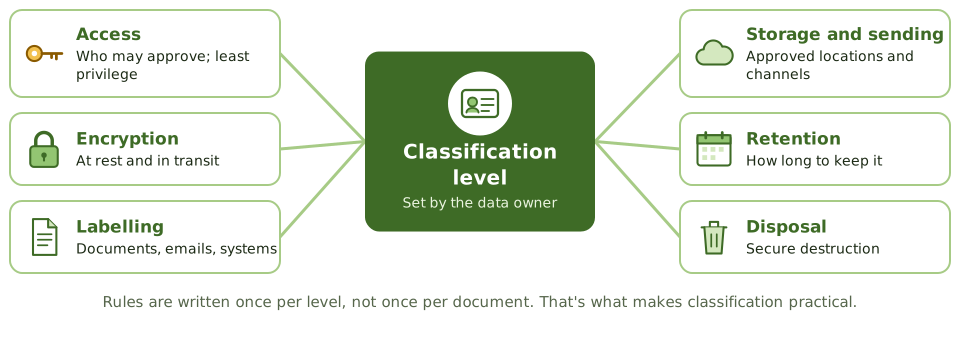
Each level has rules for:
- who may approve access, and least privilege
- encryption at rest and in transit
- labelling of documents, emails and systems
- where the data may be stored (approved cloud services, removable media)
- how it may be sent (email, file transfer)
- how long it’s kept
- how it’s securely destroyed
Doing it in practice
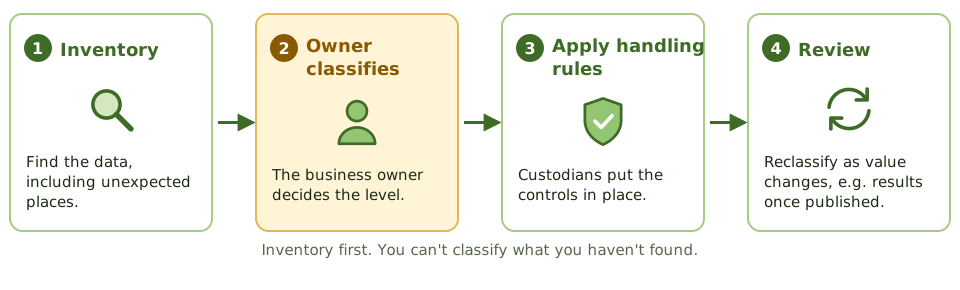
- Inventory first. You can’t classify what you haven’t found. Data discovery tools find sensitive data in unexpected places.
- Reclassify as value changes. Draft financial results are restricted until they’re published, then public.
- Aggregation can raise sensitivity. Names alone are harmless; names plus dates of birth plus addresses are an identity thief’s dream.
- Default classification: unlabelled data should default to a protective level such as internal. Otherwise it tends to get the lowest protection.
Example. An auditor finds that the HR system’s salary data is marked “internal”, the same as the canteen menu, because IT applied a single default label to every application. No business owner was ever asked. The auditor recommends owner-led classification, starting with an inventory of systems holding personal data.
How the exam asks about it
| If the question asks… | The answer is usually… |
|---|---|
| First step in protecting information assets | Inventory and classify them |
| Who determines data classification | The data owner |
| Main benefit of classification | Protection proportionate to value and sensitivity |
| Data custodian’s role | Implement controls as directed by the owner |
| Data whose sensitivity changes | Periodic review and reclassification |
In short
- Data classification groups information by sensitivity and criticality so that protection is proportionate.
- The data owner is responsible for classifying data and reviewing the classification periodically.
- Classification drives access rules, encryption, labelling, storage, transmission, retention and disposal requirements.
- Typical schemes have three to five levels, such as public, internal, confidential and restricted.
- Too many levels makes classification hard to apply; too few doesn't differentiate protection.
- Inventory first, then classify: you can't classify what you haven't identified.
Exam traps
- The first step in protecting information is identifying and classifying it.
- IT or security doesn't decide classification; the business owner does.
- Classification must be reviewed as data's value changes (for example, results become public after announcement).
- Unlabelled data is often handled at the lowest level of protection.
- Aggregation can raise sensitivity: individually harmless data can be sensitive together.
Slides
Click the slide and use the arrow keys. F toggles full screen.
A typical scheme
The level drives the rules
Doing it in practice