Topics in this domain
- Security Governance and Roles
- Data Classification and Ownership
- Security Policies
- Privacy Principles and GDPR
- Identity Management
- Authentication Factors
- Biometrics
- Access Models: DAC, MAC, RBAC
- Logical and Privileged Access
- Cryptography Basics
- Symmetric Encryption
- Asymmetric Encryption
- Hashing and Integrity
- Digital Signatures
- PKI and Certificates
- Firewalls
- IDS/IPS
- VPN, SSL/TLS, IPsec
- Wireless Security
- Endpoint and Mobile (BYOD)
- Cloud and Virtualization Security
- Physical Access Controls
- Environmental Controls: Fire, Power, HVAC
- Social Engineering
- Malware
- Network Attacks: DoS, Spoofing, Sniffing
- Application Attacks: SQLi, XSS
- Vulnerability Management and Pen Testing
- Incident Response
- Digital Forensics and Chain of Custody
- Security Awareness Training
- Logging, SIEM, and Auditing Security
Digital Signatures
A wax seal for the digital age
Letters used to be sealed with wax pressed by the sender’s personal ring. Only the ring’s owner could make that mark, and a broken seal showed someone had opened it.
A digital signature does both jobs electronically: only the holder of the private key can make it, and any change to the message breaks it.
Signing and verifying
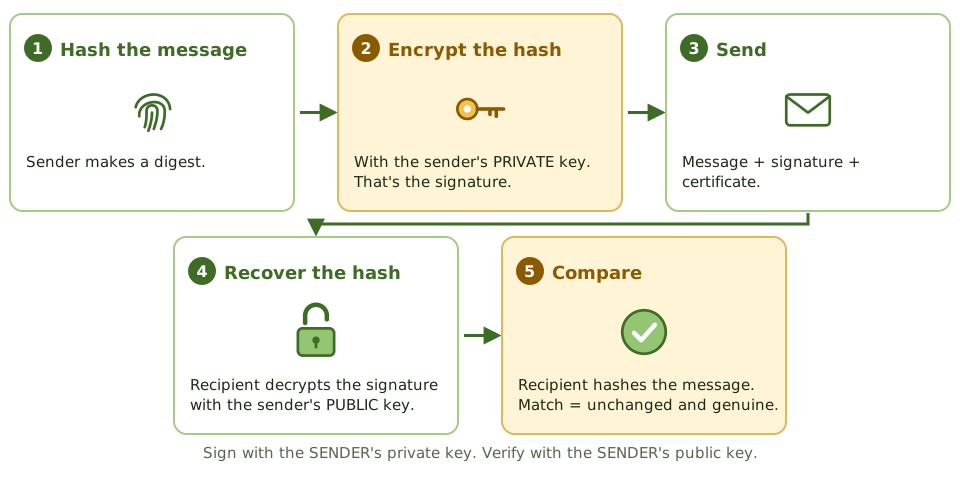
Signing
- The sender computes a hash of the message.
- The sender encrypts the hash with their own private key. The result is the digital signature.
- The message, the signature and usually the sender’s certificate are sent together.
Verifying
- The recipient decrypts the signature with the sender’s public key, getting back the original hash.
- The recipient computes their own hash of the message they received.
- If the two match, the message hasn’t changed since it was signed, and it was signed with the sender’s private key.
Only the hash is encrypted, not the whole message. Asymmetric crypto is slow, so this keeps it quick.
Memory hook: sign with the sender’s private key; verify with the sender’s public key.
What it proves, and what it doesn’t
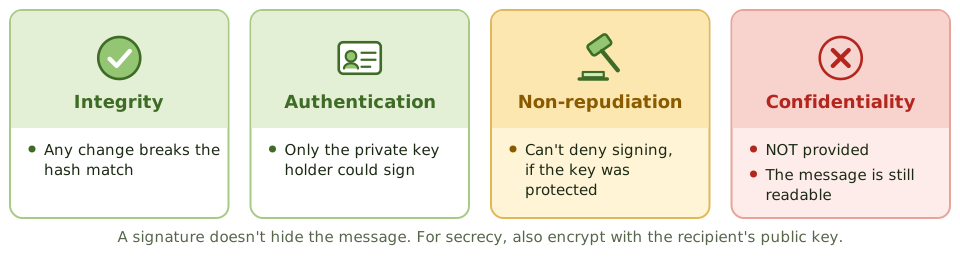
| Property | Provided? | Why |
|---|---|---|
| Integrity | Yes | Any change to the message changes its hash |
| Authentication | Yes | Only the holder of the private key could produce the signature |
| Non-repudiation | Yes | The sender can’t credibly deny signing, provided the private key was protected |
| Confidentiality | No | The message travels in readable form unless it’s also encrypted |
For secrecy as well, the sender signs with their own private key and then encrypts with the recipient’s public key.
Whose public key is it?
Verification only means something if the public key really belongs to the claimed sender. Digital certificates, issued by a trusted certificate authority, make that link. That’s the job of PKI.
Non-repudiation also depends on the private key staying under its owner’s sole control: on a smart card, token or HSM, protected by a PIN. A shared or stolen private key breaks it. A signature proves the content at signing time; a trusted timestamp proves when it was signed.
Example. A supplier disputes a purchase order, claiming it never agreed the price. The order was digitally signed with the supplier’s private key, held on a smart card issued to its sales director. Verification with the supplier’s certificate shows the order is genuine and unaltered. Non-repudiation holds.
Where signatures are used
- signed contracts and documents
- signed email (S/MIME)
- code signing, so software can be checked before installation
- signed transactions in banking and EDI
- certificates themselves, which are signed by the CA
How the exam asks about it
| If the question asks… | The answer is usually… |
|---|---|
| Key used to create a digital signature | Sender’s private key |
| Key used to verify a digital signature | Sender’s public key |
| Property a digital signature does NOT provide | Confidentiality |
| What is actually encrypted when signing | The hash (message digest) |
| What gives assurance the public key belongs to the sender | A digital certificate from a trusted CA |
In short
- A digital signature is created by hashing the message and encrypting the hash with the sender's private key.
- The recipient decrypts the signature with the sender's public key and compares the result with their own hash of the message.
- A valid signature proves integrity (unchanged), authentication (from the key holder) and non-repudiation (the sender can't deny it).
- A digital signature doesn't provide confidentiality; the message itself is still readable.
- Trust in the signature depends on trust that the public key belongs to the claimed sender, provided by a certificate.
- Non-repudiation only holds if the private key is protected and used only by its owner.
Exam traps
- Signing uses the SENDER's private key; verifying uses the SENDER's public key.
- Digital signatures don't encrypt the message; add encryption with the recipient's public key for confidentiality.
- If the private key is shared or compromised, non-repudiation is lost.
- A signature verifies the content at signing time; a timestamp proves when it was signed.
Slides
Click the slide and use the arrow keys. F toggles full screen.
Signing and verifying
What it proves, and what it doesn't