Topics in this domain
- Security Governance and Roles
- Data Classification and Ownership
- Security Policies
- Privacy Principles and GDPR
- Identity Management
- Authentication Factors
- Biometrics
- Access Models: DAC, MAC, RBAC
- Logical and Privileged Access
- Cryptography Basics
- Symmetric Encryption
- Asymmetric Encryption
- Hashing and Integrity
- Digital Signatures
- PKI and Certificates
- Firewalls
- IDS/IPS
- VPN, SSL/TLS, IPsec
- Wireless Security
- Endpoint and Mobile (BYOD)
- Cloud and Virtualization Security
- Physical Access Controls
- Environmental Controls: Fire, Power, HVAC
- Social Engineering
- Malware
- Network Attacks: DoS, Spoofing, Sniffing
- Application Attacks: SQLi, XSS
- Vulnerability Management and Pen Testing
- Incident Response
- Digital Forensics and Chain of Custody
- Security Awareness Training
- Logging, SIEM, and Auditing Security
Symmetric Encryption
One key for both
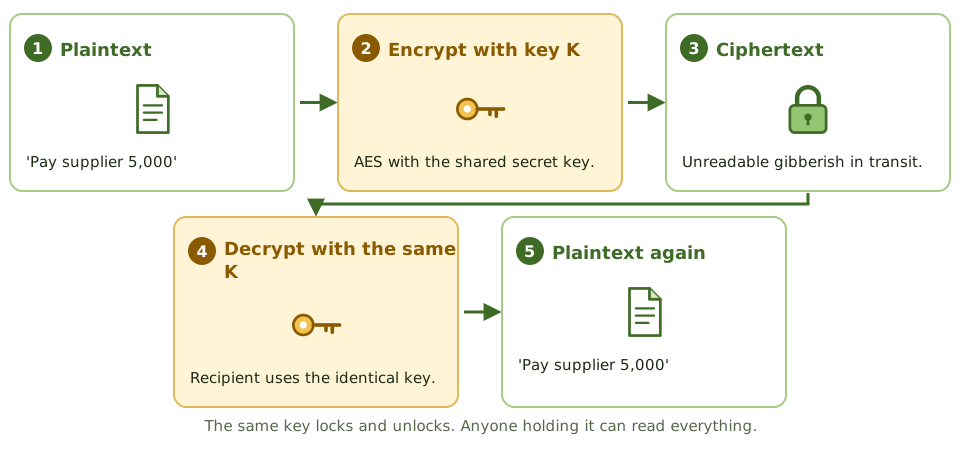
A house key locks and unlocks the same door. Give a copy to a friend and they can get in too. Lose a copy, and anyone who finds it can get in.
In symmetric (secret-key) encryption, the same key encrypts and decrypts. Anyone with the key can read the data, so the key must be kept secret and shared only with the right people.
Strengths and weaknesses
Strengths
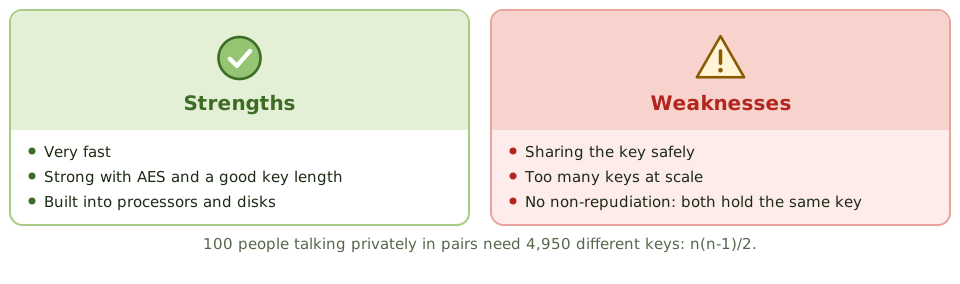
- Fast: hundreds to thousands of times faster than asymmetric encryption, so it’s used for bulk data.
- Strong: with a modern algorithm and a decent key length, brute force isn’t practical.
- Built into hardware: many processors and drives have AES support built in.
Weaknesses
- Key distribution: how do two parties agree a secret key without anyone intercepting it? This is the main disadvantage.
- Scalability: every pair of people needs its own key. For n people that’s n(n-1)/2 keys, so 100 people need 4,950.
- No non-repudiation: both parties hold the same key, so either could have created a message.
The key-sharing problem, solved
In practice, symmetric keys are shared using asymmetric cryptography: a symmetric session key is exchanged with public-key methods (as in TLS), or “wrapped” with the recipient’s public key. You get the speed of symmetric and the safe delivery of asymmetric.
Example. A company sends encrypted files to 30 partners, using the same AES key for all of them, emailed in the clear. Anyone who intercepts that email, or any one partner, can read every partner’s files. The auditor recommends a unique key per partner, exchanged with public-key methods.
Algorithms
| Algorithm | Notes |
|---|---|
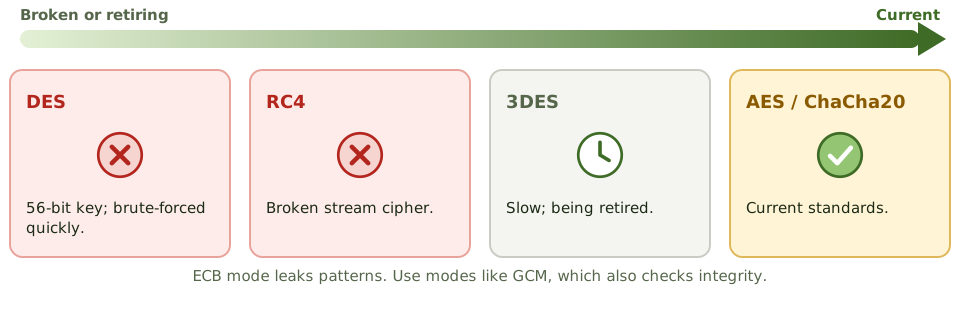
| DES | 56-bit key; obsolete and quickly broken |
| 3DES | DES applied three times; slow and being retired |
| AES | The current standard (Rijndael); 128-, 192- or 256-bit keys |
| ChaCha20 | Fast stream cipher, common on mobile devices |
| Blowfish, Twofish, IDEA | Older alternatives |
| RC4 | Broken stream cipher; don’t use |
Block ciphers (AES) encrypt fixed-size blocks; stream ciphers (ChaCha20) encrypt bit by bit. Block ciphers run in a mode of operation: ECB is insecure because identical blocks produce identical ciphertext, leaking patterns; GCM gives encryption and integrity together.
Where you’ll find it
- full-disk and file encryption
- database and backup encryption
- VPN and TLS traffic (after the key exchange)
- Wi-Fi encryption (WPA2/WPA3)
How the exam asks about it
| If the question asks… | The answer is usually… |
|---|---|
| Main disadvantage of symmetric encryption | Secure key distribution |
| Number of keys for n users | n(n-1)/2 |
| Main advantage of symmetric over asymmetric | Speed / efficiency for large data |
| Current standard symmetric algorithm | AES |
| Can symmetric encryption provide non-repudiation | No |
In short
- Symmetric encryption uses the same secret key to encrypt and decrypt.
- It's fast and efficient, so it's used for bulk data: disks, databases, files, network sessions.
- The main problem is key distribution: both parties need the key, and it must be shared securely.
- Scalability: n users communicating privately need n(n-1)/2 keys.
- Symmetric encryption alone doesn't provide non-repudiation, because both parties hold the same key.
- AES is the current standard; DES is obsolete and 3DES is being retired.
Exam traps
- Biggest disadvantage of symmetric encryption: securely distributing the key.
- Symmetric can't prove which party sent a message, so no non-repudiation.
- ECB mode leaks patterns; use modes such as GCM or CBC with proper initialisation vectors.
- Key length matters: 56-bit DES can be brute-forced quickly.
Slides
Click the slide and use the arrow keys. F toggles full screen.
One key for both
A house key locks and unlocks the same door. Give a copy to a friend and they can get in too. Lose a copy and anyone who finds it can get in.
Symmetric encryption works the same way: the same secret key encrypts and decrypts. Anyone with the key can read the data.
Strengths and weaknesses
Algorithms