Topics in this domain
- Security Governance and Roles
- Data Classification and Ownership
- Security Policies
- Privacy Principles and GDPR
- Identity Management
- Authentication Factors
- Biometrics
- Access Models: DAC, MAC, RBAC
- Logical and Privileged Access
- Cryptography Basics
- Symmetric Encryption
- Asymmetric Encryption
- Hashing and Integrity
- Digital Signatures
- PKI and Certificates
- Firewalls
- IDS/IPS
- VPN, SSL/TLS, IPsec
- Wireless Security
- Endpoint and Mobile (BYOD)
- Cloud and Virtualization Security
- Physical Access Controls
- Environmental Controls: Fire, Power, HVAC
- Social Engineering
- Malware
- Network Attacks: DoS, Spoofing, Sniffing
- Application Attacks: SQLi, XSS
- Vulnerability Management and Pen Testing
- Incident Response
- Digital Forensics and Chain of Custody
- Security Awareness Training
- Logging, SIEM, and Auditing Security
Environmental Controls: Fire, Power, HVAC
Fire, water, power, heat
Servers hate the same things your phone does: being dropped in water, overheating, and the power going off in the middle of something important.
Environmental controls protect computer rooms from power problems, fire, water and heat. They only work if they’re tested and maintained.
Power
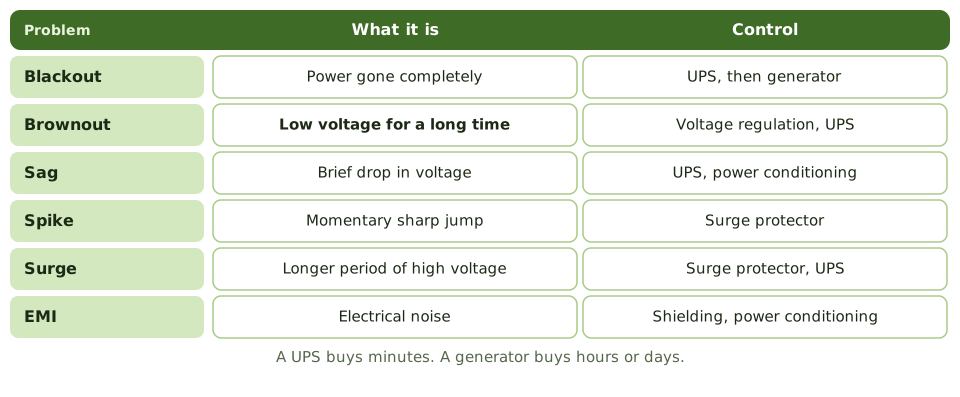
| Problem | What it is | Control |
|---|---|---|
| Blackout | Power gone completely | UPS straight away, then a generator |
| Brownout | Low voltage for a long period | Voltage regulation, UPS |
| Sag | A brief dip in voltage | UPS, power conditioning |
| Spike | A momentary sharp jump in voltage | Surge protector |
| Surge | A longer period of high voltage | Surge protector, UPS |
| Electromagnetic interference (EMI) | Electrical noise affecting equipment | Shielding, power conditioning |
- Surge protectors guard against spikes and surges.
- A UPS (uninterruptible power supply) runs on batteries through short outages and allows an orderly switch to the generator or a controlled shutdown. It also smooths the power. It buys minutes.
- Generators cover long outages. They need fuel, maintenance and regular testing under load.
- Dual power feeds from separate substations add resilience.
Detecting fire
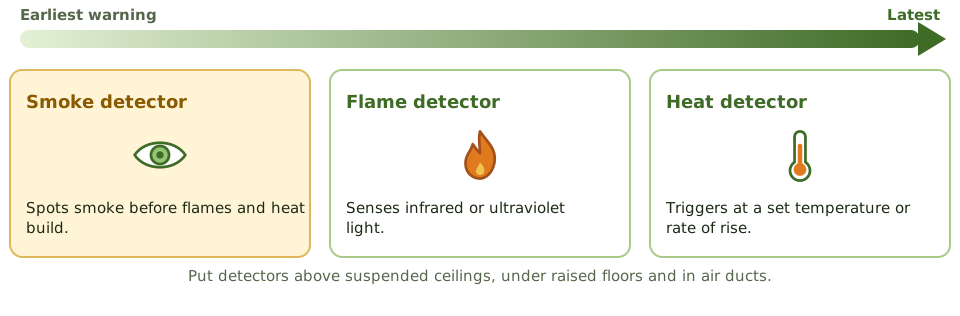
- Smoke detectors give the earliest warning, before flames and heat build up.
- Flame detectors sense infrared or ultraviolet light.
- Heat detectors trigger at a set temperature, or when it rises fast.
Detectors go above suspended ceilings, under raised floors and in air ducts, linked to a monitored alarm panel, with manual fire alarms near the exits.
Water-based suppression
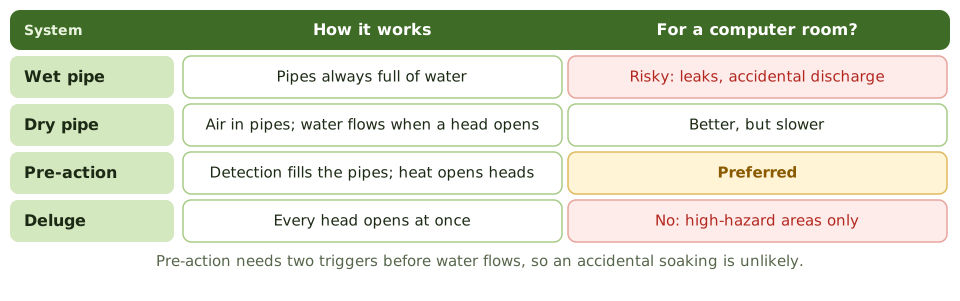
| System | How it works |
|---|---|
| Wet pipe | Pipes are always full of water; each head opens with heat. Reliable, but leaks and accidental discharge can soak equipment |
| Dry pipe | Pipes hold pressurised air; water flows only when a head opens. Less leak risk, slower to respond |
| Pre-action | Water enters the pipes only after detection (first trigger), and comes out only where heat opens a head (second trigger). Preferred for computer rooms, because an accidental soaking is unlikely |
| Deluge | Every head opens at once, releasing huge volumes of water. For high-hazard areas, not computer rooms |
Gas-based suppression
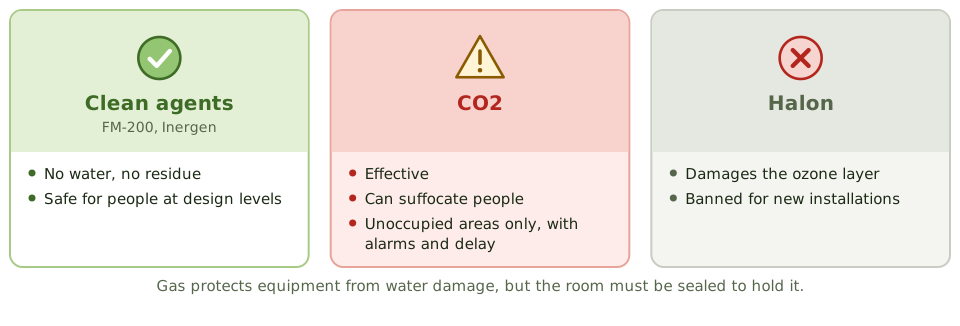
- Clean agents such as FM-200 and Inergen put out fires without water damage or residue, and are safe for people at design concentrations. The room must be sealed to hold the gas.
- CO2 works, but can suffocate people. Only for unoccupied areas, with warning alarms and a delay before release.
- Halon damages the ozone layer and is banned for new installations.
The rest of the room
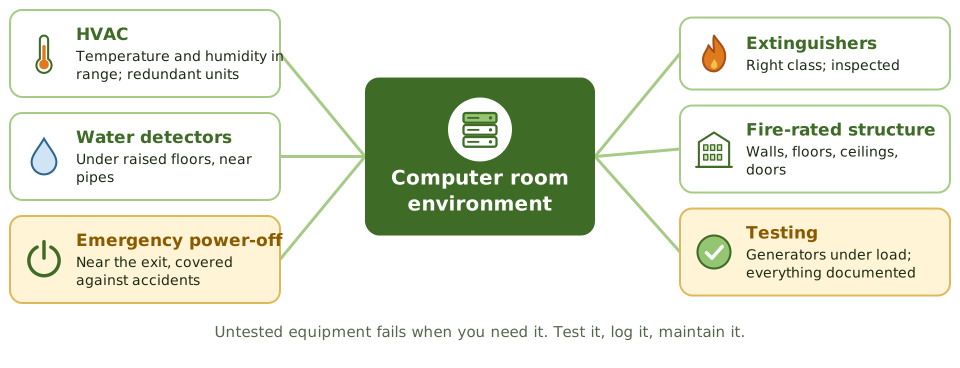
- HVAC keeps temperature and humidity within equipment specifications, with redundant units. Too dry causes static; too humid causes corrosion and condensation.
- Water detectors under raised floors and near pipes.
- An emergency power-off (EPO) switch near the exit, with a cover so nobody hits it by accident.
- Fire extinguishers of the right class, inspected regularly.
- Fire-resistant walls, floors, ceilings and doors around the computer room.
- Raised floors for cabling and airflow.
- Regular inspection and testing of everything, documented. Untested equipment fails exactly when you need it.
Example. During a power cut, the UPS keeps the data centre running for 12 minutes, but the generator won’t start: its fuel had degraded and it hadn’t been tested under load for two years. Systems shut down uncleanly. The finding is about maintenance and testing, not the design.
How the exam asks about it
| If the question asks… | The answer is usually… |
|---|---|
| Preferred water system for computer rooms | Pre-action |
| Suppression system dangerous to people | CO2 |
| Device for short outages and power conditioning | UPS |
| Control for prolonged outages | Generator |
| Earliest fire detection | Smoke detectors |
| Prolonged low voltage | Brownout |
| Why environmental equipment must be tested | Untested systems may fail when needed |
In short
- Power problems include blackouts, brownouts (prolonged low voltage), sags, spikes, surges and electromagnetic interference.
- Surge protectors handle spikes; UPS bridges short outages and conditions power; generators cover prolonged outages.
- Water-based suppression: wet pipe (always charged), dry pipe (water enters on activation), pre-action (two triggers, preferred for computer rooms), deluge (all heads open).
- Gas-based suppression (FM-200, Inergen, other clean agents) protects equipment without water damage; CO2 is dangerous to people; Halon is banned for new installations.
- Smoke detectors give earlier warning than heat detectors; detectors should be above the ceiling, below raised floors and in air ducts.
- HVAC controls temperature and humidity; water detectors under raised floors detect leaks.
- Emergency power-off switches, fire extinguishers and regular testing and inspection complete the picture.
Exam traps
- Pre-action is the preferred water system for computer rooms because it reduces accidental discharge.
- Wet-pipe systems risk leaks and accidental discharge; deluge systems are unsuitable for computer rooms.
- CO2 suppression is dangerous to humans in occupied areas.
- A UPS isn't designed for long outages; a generator is.
- Environmental controls must be tested and maintained; an untested generator may not start.
Slides
Click the slide and use the arrow keys. F toggles full screen.
Power problems
Detecting fire
Water-based suppression
Gas-based suppression
The rest of the room